
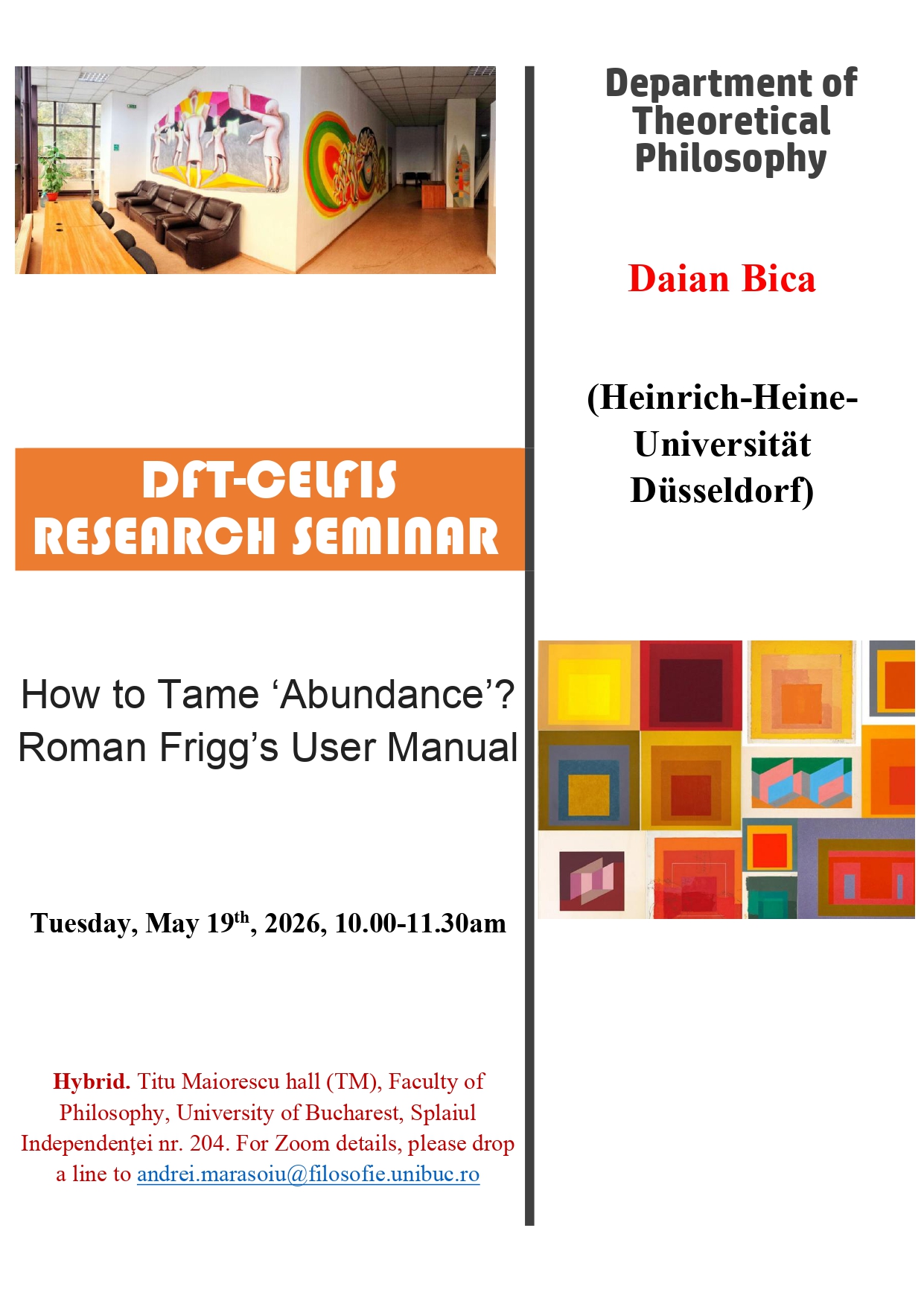
Următoarea prezentare din cadrul seriei de seminare de cercetare ale Departamentului de Filosofie Teoretică în parteneriat cu CELFIS va fi susținută de Daian Bica, recent doctor al Heinrich-Heine-Universität Düsseldorf și absolvent al masteratului Analytic Philosophy al facultății noastre. Mai multe detalii despre vorbitor puteți afla aici: https://www.philosophie.hhu.
Titlul prezentării sale DFT-CELFIS este ”How to Tame ‘Abundance’? Roman Frigg’s User Manual”. Iată un rezumat:
”Model pluralism pervades scientific practice (Weit, 2019), as multiple kinds of models are often employed to investigate the properties and structures of the same phenomenon. The proliferation of multiple models targeting the same phenomenon has generated what Roman Frigg (2022) calls the “problem of abundance” referring to the existence of multiple, often incompatible yet empirically successful models representing a single target system. Nuclear physics exemplifies this problem: liquid-drop, shell, and quark models each capture salient features of nuclear behaviour while endorsing fundamentally different ontologies (Morrison, 2015). More generally, the problem of abundance can be summarized as “many models, one target” and raises two key questions: (1) what motivates the construction of multiple models of the same target, and (2) what strategies are available for managing the resulting abundance (Frigg, 2022, p. 40).This presentation evaluates whether perspectival realism offers a viable response to both questions. Perspectival realism is a recent trade-off position, resulting between two distinct pluralist and realist commitments (Bica, 2026). In this sense, I analyse three contemporary interpretations of perspectival realism: Giere’s epistemic account emphasizes that multiple models represent limited and partial aspects of their target systems (Giere, 2006). However, it struggles to clarify in what sense this view constitutes a stable trade-off. Mitchell’s ontic view by contrast, focuses on how models, as partial and incomplete representations, target level-relative causal structures (Mitchell, 2019). Mitchell addresses the problem of abundance by proposing the concept of model integration. According to this concept, distinct models at different levels can be combined to achieve multilevel integration. Nonetheless, I argue that such integration may not always be achievable in all cases of model pluralism.Finally, Massimi’s modal approach redirects attention to how allegedly incompatible models generate modal knowledge and enable a form of physical conceivability (Massimi, 2022). In this respect, her account provides a robust strategy for navigating the problem of abundance,
or so I will argue.”
Conferinţa va avea hibrid marți, 19 mai, orele 10.00-11.30 dimineața. Cei ce participăm faţă în faţă ne întâlnim în amfiteatrul ‘Titu Maiorescu’, etajul 1, de la sediul Facultății de Filosofie din Splaiul Independenței nr. 204, București. Însă vorbitorul se va conecta de la distanță. Pentru detaliile Zoom de participare vă rugăm scrieți-i lui andrei.marasoiu@filosofie.
Mai multe detalii despre seria DFT-CELFIS din acest an puteţi afla aici: https://philevents.org/