Seminar cercetare DFT „Eternalism and Libertarian Free Will: Are We Free without an Open Future?”

Următoarea conferință online din cadrul seminarului de cercetare al Departamentului de Filosofie Teoretică în parteneriat cu CELFIS din semestrul al II-lea al anului 2022/2023 va fi susținută de Bogdan Dumitrescu (Universitatea din București). Prezentarea sa este intitulată „Eternalism and Libertarian Free Will: Are We Free without an Open Future?”. Conferința se va desfășura miercuri, 10 mai, orele 17.00-18.30, în amfiteatrul „Titu Maiorescu”, etajul 1, de la sediul Facultățîi de Filosofie: Splaiul Independenței nr. 204, București 060024. Iată un rezumat extins al comunicării sale: „Free will is taken to be in conflict with determinism. This is the most popular way of framing the problem of free will. In this presentation I am concerned with a different, less popular, way of viewing the problem: the inconsistency of free will with certain metaphysical theories of time. The idea that freedom is actually in tension with our metaphysical assumptions on time has been popularized by Carl Hoefer (2002), but even before his article was published, philosophers such as Niall Shanks (1994) have argued that if certain metaphysical theories of time are true, then human freedom is under threat. If, for example, the future is settled and not open to possibilities, then how can we still maintain that we have control over future events?

            The A-theory of time is the one that seems to accommodate best our everyday assumptions about time such as the belief in temporal passage, an objective present and an open future. However, it is eternalism (also known as the block universe or the B-theory of time) that seems to be best compatible with contemporary physical theories, but this theory, as Shanks (1994) and others have argued, is in conflict with freedom of the will. This is because eternalism holds that there is no ontological distinction of kind between past events, present events and future events. Since all temporal events are equally real in eternalism, this means that future events are just as real and fixed as past and present events. Consequently, this would mean that the future is not unsettled and open to possibilities, as commonly believed.

            This conflicts with the libertarian conception of free will. Freedom understood as the ability to do otherwise requires that an agent have multiple possible alternatives from which to choose at the moment of choice. But if eternalism is true and the future is not open, then it seems, at least prima facie, that freedom to do otherwise is a mere illusion which exists only due to our epistemic ignorance of what the future will be.

            In this talk, my aim is to briefly survey the most popular metaphysical theories within the analytic philosophy of time (A-theories and the B-theory) and explore the compatibility between the libertarian free will and eternalism (more specifically, the compatibility between freedom and a fixed, non-open future). I will also briefly comment on Nathan Oaklander’s (2004) response to Niall Shanks’ main argument.”

Seminar cercetare DFT „Arithmetic and proto-arithmetic: the need for clear conceptual distinctions in research on numerical cognition”

Următoarea conferință online din cadrul seminarului de cercetare al Departamentului de Filosofie Teoretică în parteneriat cu CELFIS din semestrul al II-lea al anului 2022/2023 va fi susținută de Markus Pantsar (University of Helsinki & RWTH Aachen; https://scholar.google.com/citations?user=0F4V0P8AAAAJ&hl=en).

Prezentarea sa este intitulată „Arithmetic and proto-arithmetic: the need for clear conceptual distinctions in research on numerical cognition”.

Conferința se va desfășura joi, 4 mai, orele 16.00-17.30, în amfiteatrul „Constantin Rădulescu-Motru”,etajul 1, de la sediul Facultății de Filosofie: Splaiul Independenței nr. 204, București 060024. 

Seminar cercetare DFT „Are moral analogies deductive?”

Următoarea conferință online din cadrul seminarului de cercetare al Departamentului de Filosofie Teoretică în parteneriat cu CELFIS din semestrul al II-lea al anului 2022/2023 va fi susținută de prof. Dragoș Bîgu (ASE; https://ase.academia.edu/DragosBigu). Prezentarea sa este intitulată „Are moral analogies deductive?” O carte recentă a sa este „Paradigmă și incomensurabilitate”, Editura All, 2009. Conferința se va desfășura miercuri, 12 aprilie, orele 14.-15.30 la sediul Facultățîi de Filosofie: Splaiul Independenței nr. 204, București 060024. Pentru cei ce nu pot ajunge fizic, există opțiunea conectării prin Zoom: dacă doriți detaliile, vă rugam contactați-l pe andrei.marasoiu@filosofie.unibuc.ro

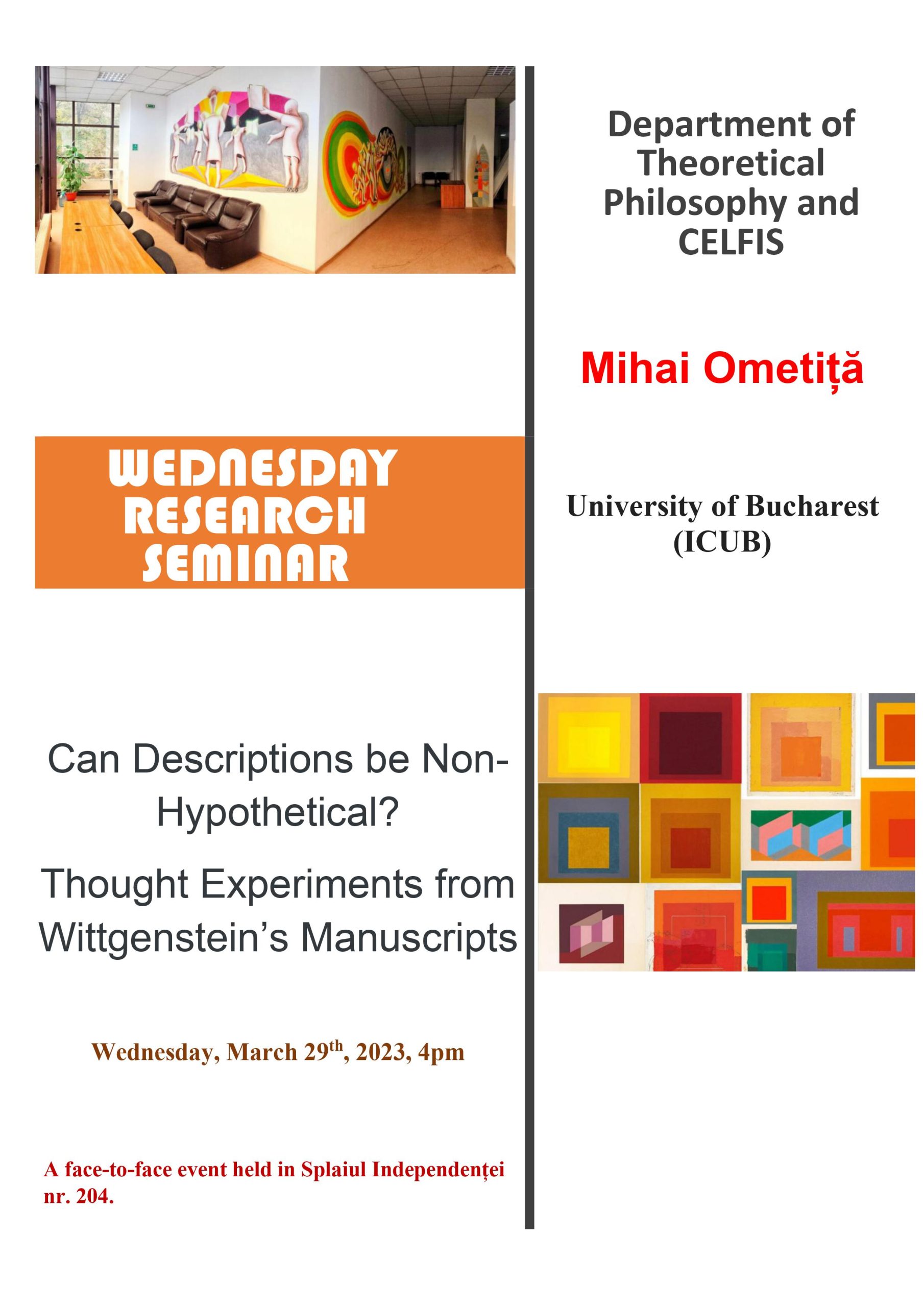
Seminar cercetare DFT ‘Can Descriptions be Non-Hypothetical? Thought Experiments from Wittgenstein’s Manuscripts’

Următoarea conferință online din cadrul seminarului de cercetare al Departamentului de Filosofie Teoretică în parteneriat cu CELFIS din semestrul al II-lea al anului 2022/2023 va fi susținută de dr.  Mihai Ometiță (Universitatea din București, ICUB). Prezentarea sa este intitulată ‘Can Descriptions be Non-Hypothetical? Thought Experiments from Wittgenstein’s Manuscripts’. Iată un rezumat:

‘In manuscripts around 1930, Wittgenstein characterizes ordinary language as hypothesis-laden and envisages what he calls a “phenomenological language”, which would provide non-hypothetical descriptions of experience. I will first reconstruct that under-explored project, which illuminates the transition from the Tractatus to the Philosophical Investigations. Then I will discuss several thought experiments which Wittgenstein devices in order to test the viability of a phenomenological language. The methodological moral I advance is that the price to be paid for the attempt to provide non-hypothetical descriptions is one’s estrangement from intelligibility.’

Conferința se va desfășura fizic ȋn limba engleză miercuri, 29 martie, orele 16.00-17.30 la sediul Facultății de Flosofie: Splaiul Independenței nr. 204, București 060024.

Seminar cercetare DFT ‘Reference and Institutions’

Următoarea conferință online din cadrul seminarului de cercetare al Departamentului de Filosofie Teoretică în parteneriat cu CELFIS din semestrul al II-lea al anului 2022/2023 va fi susținută de dr. Andreea Popescu (Universitatea din București, ICUB). O prezentare anterioară a sa este disponibilă aici: https://www.youtube.com/watch?v=spqMxvvVcOo Și iată un atelier recent co-organizat de dr. Popescu: https://isosonline.org/Themes-from-Raimo-Tuomelas-Social-Ontology Prezentarea sa este intitulată ‘Reference and Institutions’. Conferința se va desfășura fizic ȋn limba engleză miercuri, 15 martie, orele 18.00-20.00, la sediul Facultății de Flosofie: Splaiul Independenței nr. 204, București 060024.

Detaliile de conectare via Zoom vor fi distribuite celor ce își indică dorința de participare scriind la adresa andrei.marasoiu@filosofie.unibuc.ro Puteți consulta şi anunțul de pe pagina Facebook a seminarului: https://www.facebook.com/Seminarul-Departamentului-de-Filosofie-Teoretica-UniBuc-285279685738329 sau de pe PhilEvents: https://philevents.org/event/show/105249

Seminar cercetare DFT ‘Just-So Stories Lack Modal Depth’

Următoarea conferință online din cadrul seminarului de cercetare al Departamentului de Filosofie Teoretică în parteneriat cu CELFIS din semestrul I al anului 2022/2023 va fi susținută de dr. Ilmari Hirvonen și Pekka Syrjänen (Universitatea din Helsinki). Mai multe detalii despre vorbitori sunt disponibile la https://philpeople.org/profiles/ilmari-hirvonen şi, respectiv, https://www.researchgate.net/profile/Pekka-Syrjanen Prezentarea lor este intitulată ‘Just-So Stories Lack Modal Depth’. Iată un rezumat:

‘A common feature of pre-scientific, non-scientific, unscientific, and pseudoscientific explanations – including conspiracy theories – is that they invoke just-so stories. We argue that the problem with just-so stories is that they lack modal depth: they merely describe what is actual or already observed without explicating what is otherwise possible, impossible, contingent, or necessary. A theory’s lack of modal depth is detectable from its inability to imply counterfactual claims. In other words, a modally shallow theory has difficulties answering such questions as “How things would have been if a variable had been different?” or “How would things be if some variable was held constant while another one was changing?” Without modal depth, a theory cannot make genuine predictions. Without genuine predictions, the parts of a theory that conjure unobserved entities or processes are difficult—or perhaps even impossible—to evaluate and, therefore, for the time being, scientifically unjustified. In some cases, explanations invoking just-so stories nevertheless have modal depth. However, their counterfactual claims are either false or inscrutable. We illustrate our claims with examples of conspiracy theories (QAnon, Moon landing hoax) and pseudohistory (ancient aliens, historical miracles).’

Conferința se va desfășura ȋn limba engleză joi, 19 ianuarie, orele 18.00-20.00. Detaliile de conectare via Zoom vor fi distribuite celor ce își indică dorința de participare scriind la adresa andrei.marasoiu@filosofie.unibuc.ro Puteți consulta şi anunțul de pe pagina Facebook a seminarului: https://www.facebook.com/Seminarul-Departamentului-de-Filosofie-Teoretica-UniBuc-285279685738329 sau de pe PhilEvents: https://philevents.org/event/show/105249