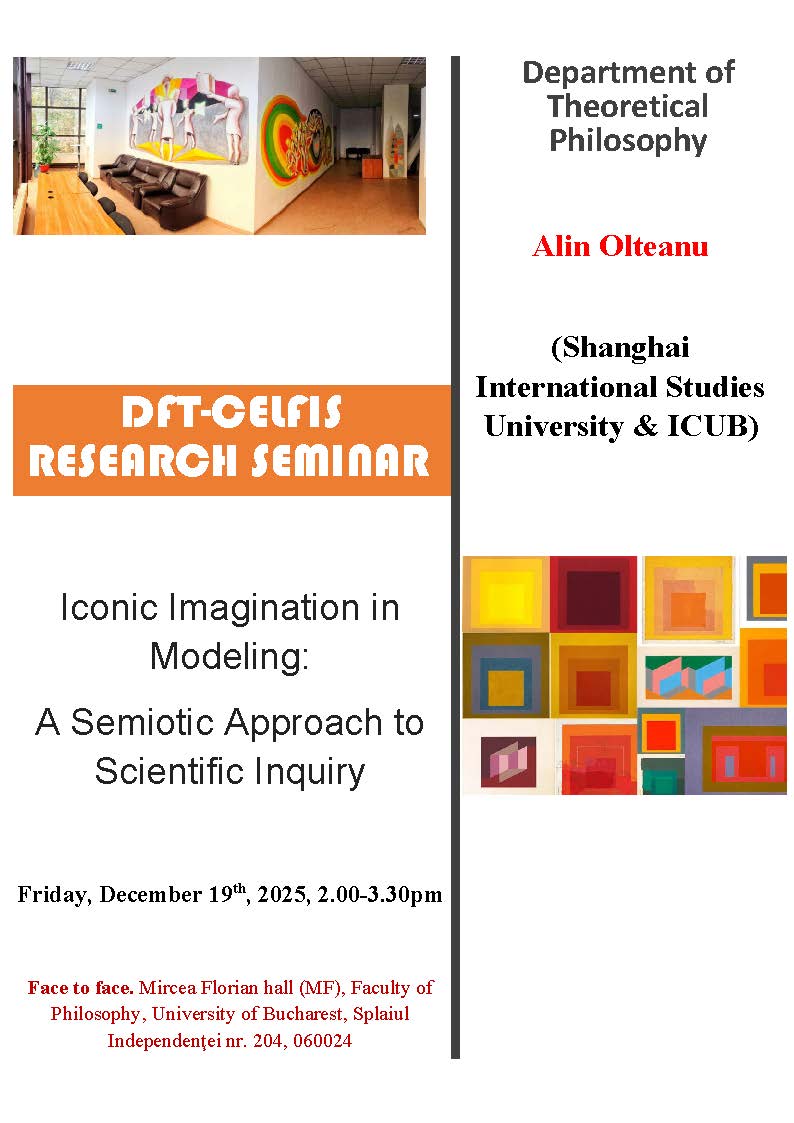
Seminar cercetare DFT ‘Iconic Imagination in Modeling: A Semiotic Approach to Scientific Inquiry’

Următoarea prezentare din cadrul seriei de seminare de cercetare ale Departamentului de Filosofie Teoretică în parteneriat cu CELFIS aparține lui Alin Olteanu (Shanghai International Studies University & ICUB).
Titlul prezentării sale este ‘Iconic Imagination in Modeling: A Semiotic Approach to Scientific Inquiry’. Un rezumat este anexat. Textul se bazează pe articolul său omonim disponibil aici: https://www.ingentaconnect.com/contentone/imp/chk/2025/00000031/f0020003/art00003?crawler=true&mimetype=application/pdf 
Prezentarea se va desfășura faţă-în-faţă, vineri, 19 decembrie 2025, orele 14.00-15.30, în amf. Mircea Florian, etajul 1 la sediul Facultății de Filosofie din Splaiul Independenței nr. 204, București 060024. Mai multe detalii despre seria DFT-CELFIS din acest an puteţi afla aici: https://philevents.org/event/show/141649 

Iconic Imagination in Modeling: A Semiotic Approach to Scientific Inquiry

I propose a semiotic contribution to philosophy of science in regard to imagination.
Often associated with the discovery of novel order and creativity, the imagination has been traditionally overlooked in philosophy of science. As recent cognitive sciences are placing imagination (Brandt 2020; Paolucci 2021) at the centre of all mind work, as capacity to meaningfully organize mental representations, philosophical reflection on scientific inquiry has also begun to pay attention to it (Frigg 2010; Levy & Godfrey-Smith 2020).

I reflect on the role of imagination in scientific inquiry by adopting three connected theories:
(1) Charles S. Peirce’s semiotics (CP 7.206–217; 7.366),
(2) cognitive semantics, and
(3) cognitive semiotics.

My argument is that while imagination is at work at every step of scientific inquiry, it particularly consists in abductive inferences, the incipient stage of hypothesizing (CP 1.46; 5.181). Proposing a hypothesis requires imagining it.

On this view, I construe the work of imagination in the context of (scientific) modeling as icon (signifying similarities, CP 3.362) manipulation. I argue that scientific inquiry unfolds within media affordances that at the same time make discovery possible and constrain it. From this perspective, understanding scientific inquiry requires considering situatedness (Massimi 2022), both cognitive and technological.

I explain that this semiotic conceptualization can shed light on the expansion of human imagination through emerging technologies, among which, most prominent, electronic computers. To develop my argument, I explicate some anecdotes of scientific discovery as icon manipulation, with a consideration of the heuristics stemming from modeling as transmedial.

Keywords: icon; modeling; imagination; simulation; scientific inquiry.

References

Brandt, P. A. (2020). Cognitive semiotics: Signs, mind and meaning. Bloomsbury.
Frigg, R. (2010). Models and fiction. Synthese, 172, 251–268.
Levy, A., & Godfrey-Smith, P. (Eds.). (2020). The scientific imagination: Philosophical and psychological perspectives. Oxford University Press.
Massimi, M. (2022). Perspectival realism. Oxford University Press.
Paolucci, C. (2021). Cognitive semiotics: Integrating signs, minds, meaning and cognition. Springer.
Peirce, C. S. (1958). The collected papers of Charles Sanders Peirce (Vols. 1–8, C. Hartshorne, P. Weiss, & A. W. Burks, Eds.). Harvard University Press.

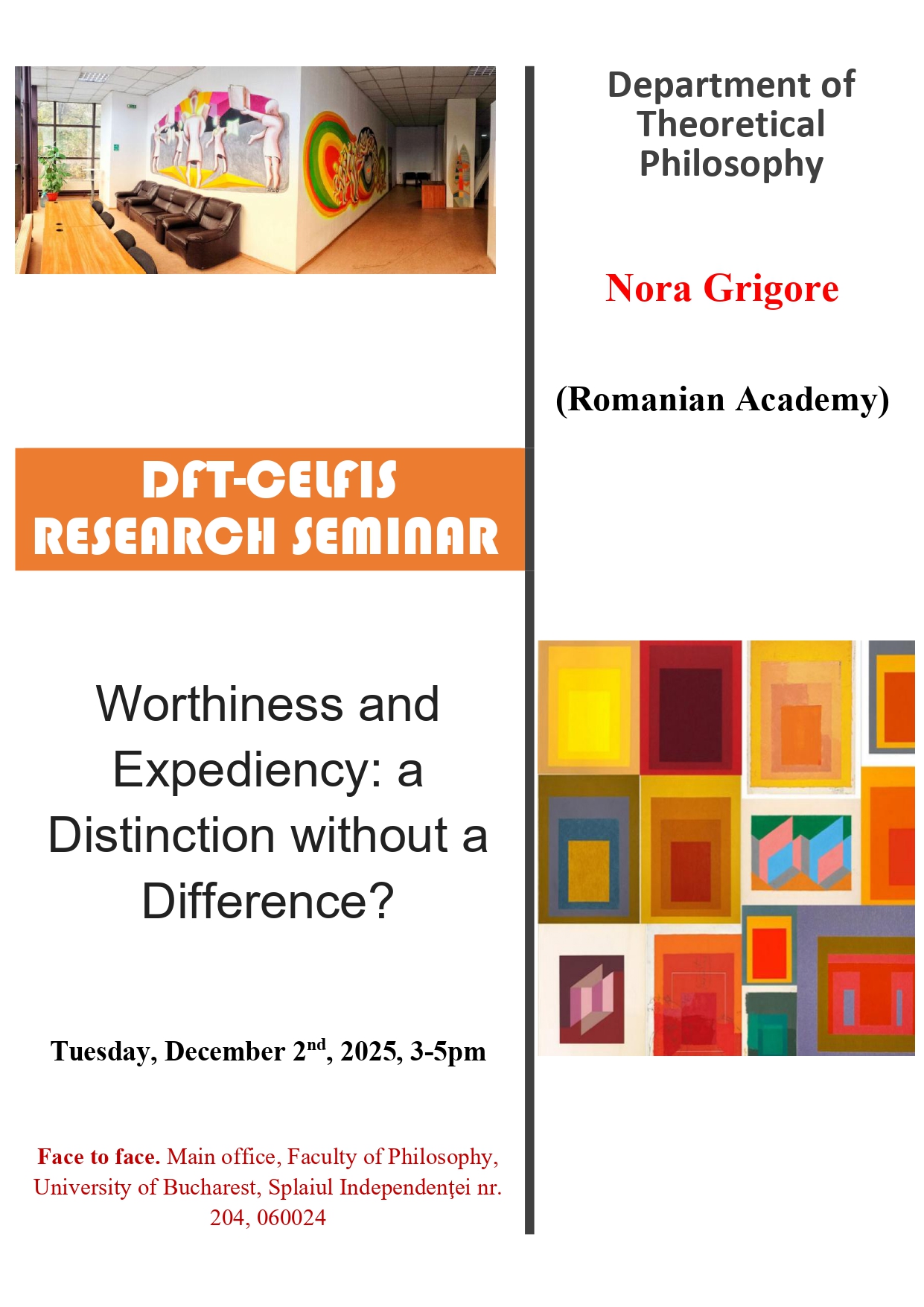
Seminar cercetare DFT ‘Worthiness and Expediency: a Distinction without a Difference?’

Următoarea prezentare din cadrul seriei de seminare de cercetare ale Departamentului de Filosofie Teoretică în parteneriat cu CELFIS aparține Norei Grigore (Academia Română, Institutul de Filosofie şi Psihologie ‘Constantin Rădulescu-Motru’). 
Titlul prezentării sale este ‘Worthiness and Expediency: a Distinction without a Difference?’ Mai multe detalii despre cercetarea sa puteţi afla la: https://scholar.google.com/citations?hl=en&user=-mxrtAkAAAAJ  
Prezentarea se va desfășura faţă-în-faţă, marţi, 2 decembrie 2025, orele 15.00-16.45, la sediul Facultății de Filosofie din Splaiul Independenței nr. 204, București 060024. Mai multe detalii despre seria DFT-CELFIS din acest an puteţi afla aici: https://philevents.org/event/show/141649

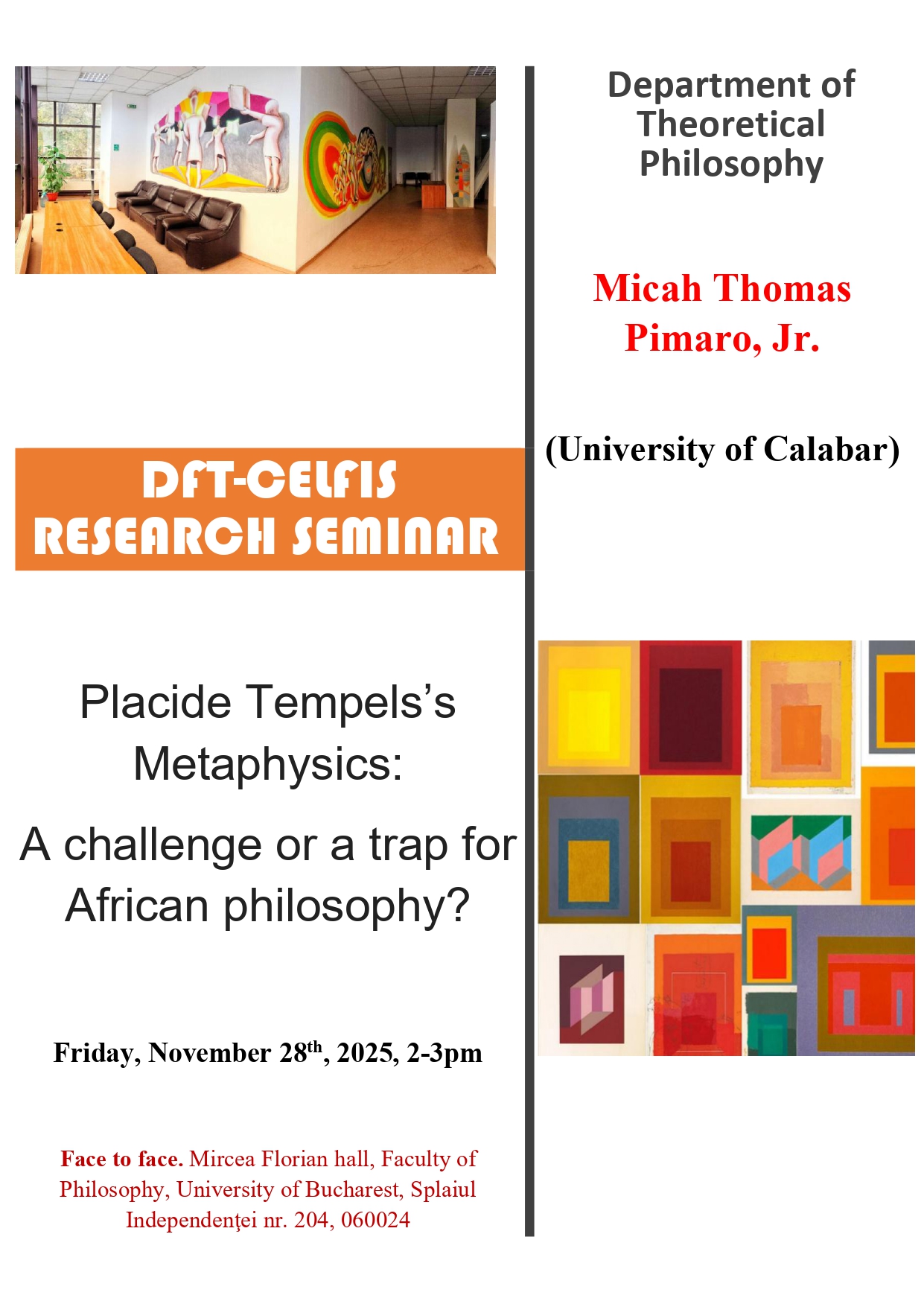
Seminar cercetare DFT ‘Placide Tempels’s Metaphysics: A challenge or a trap for African philosophy?’

Următoarea prezentare pe anul 2025/2026 din cadrul seriei de seminare de cercetare ale Departamentului de Filosofie Teoretică în parteneriat cu CELFIS aparține lui Micah Thomas Pimaro Jr. (Universitatea din Calabar, Nigeria), ce şi-a susţinut recent şi disertaţia doctorală în cadrul facultăţii noastre.  
Titlul prezentării sale este ‘Placide Tempels’s Metaphysics: A challenge or a trap for African philosophy?’. Iată un rezumat al comunicării: 
In this talk, I examine Tempels’s Bantu Philosophy (1945/1959), which identifies Force as the central ontological category of the Bantus such that being is Force. I situate his claims in dialogue with Hountondji’s African Philosophy: Myth and Reality (1976/1983), which critiques ethnophilosophy for imposing external categories and conflating collective beliefs with philosophy. I outline Tempels’s three possible relations: being as distinct from force, force as part of being, and being as force, and note his view that Bantu thought embraces the third, according to which being and force are identical. I analyze whether this framework can allow a genuine philosophical encounter or, as Hountondji argues, it is a colonial construction. I further explore how Force functions methodologically, shaping and being shaped by interpretive frameworks. Revisiting the fundamental question of “What is it?” reveals Force as both an ontological principle and an analytic tool. I conclude by showing how Hountondji’s methodological rigor offers a framework to refine African metaphysical categories for contemporary engagement.  
Prezentarea se va desfășura faţă-în-faţă, vineri, 28 noiembrie 2025, orele 14.00-15.30, în amf. Mircea Florian de la etajul 1 al Facultății de Filosofie din Splaiul Independenței nr. 204, București 060024. 

Seminar cercetare DFT ‘A Metaphysics of Despair’

A doua prezentare pe anul 2025/2026 din cadrul seriei de seminare de cercetare ale Departamentului de Filosofie Teoretică în parteneriat cu CELFIS aparține lui Nicholas Rimell (Chinese University of Hong Kong). 
Titlul prezentării sale este ‘A Metaphysics of Despair’. Mai multe detalii despre prof. Rimell sunt aici: https://nicholasrimell.weebly.com/  https://www.phil.arts.cuhk.edu.hk/web/academic/rimell-nicholas/  https://philpeople.org/profiles/nicholas-kirk-rimell 
Prezentarea se va desfășura marţi, 25 noiembrie 2025, orele 16.00-17.00, în amf. Constantin Rădulescu-Motru de la etajul 1 al Facultății de Filosofie din Splaiul Independenței nr. 204, București 060024. 
Vorbitorul va fi online via Zoom, dar mulţi dintre noi vom fi în sală. Aşadar, formatul este hibrid. Link-ul Zoom este: https://us02web.zoom.us/j/81751729271?pwd=2eRc0pKuosImfz0tz6pZulXl4k560o.1 

Seminar cercetare DFT   ‘The Inconstant Moral Expert: the case of LLMs’

Prima prezentare pe anul 2025/2026 din cadrul seriei de seminare de cercetare ale Departamentului de Filosofie Teoretică în parteneriat cu CELFIS aparține  lect. dr. Alexandru Dragomir şi Andrei Mărăşoiu. Titlul prezentării faţă-în-faţă a acestora este ‘The Inconstant Moral Expert: the case of LLMs’.
Prezentarea se va desfășura marţi, 28 octombrie 2025, orele 17.00-18.00, în amf. Constantin Rădulescu-Motru de la etajul 1 al Facultății de Filosofie din Splaiul Independenței nr. 204, București 060024. 

Seminar cercetare DFT  „A functionalist boost to perspectivism on the DEKI playground”

Următoarea prezentare din cadrul seriei de seminare de cercetare ale Departamentului de Filosofie Teoretică în parteneriat cu CELFIS aparține  prof. Ioan Muntean (University of Texas at Rio Grande Valley & University of Illinois Urbana Champaign). Titlul prezentării sale faţă în faţă este A functionalist boost to perspectivism on the DEKI playground. Iată un rezumat:
”This paper proposes a functional approach to ‘perspectival realism’—especially in its most recent form, developed by M. Massimi (Massimi 2016; 2018; 2019; Massimi and McCoy 2020) and P. Teller (Teller 2018; 2020)—by providing a functional role of perspectives in the ‘representational success’ of scientific models. The paper promotes a probabilistic account of the role perspectives play in the representational function of models and, as part of the argument, addresses two issues: (a) the convergence of models based on different perspectives and (b) the role of perspectives in the scientific entailment from ensembles of models. We offer an example inspired by a computational model. In general, this paper connects better perspectives to the representational function of models and promotes perspectival realism as a promising framework for discussing computational models within a scientific realism framework.”
 
Şi câteva referinţe bibliografice cheie: 
Massimi, Michela. 2016. “Three Tales of Scientific Success.” Philosophy of Science 83 (5): 757–67. https://doi.org/10.1086/687861.———. 2018. “Perspectival Modeling.” Philosophy of Science 85 (3): 335–59.
———. 2019. “Two Kinds of Exploratory Models.” Philosophy of Science 86 (5): 869–81. https://doi.org/10.1086/705494.
Massimi, Michela, and Casey D. McCoy, eds. 2020. Understanding Perspectivism: Scientific Challenges and Methodological Prospects. 1st ed. Routledge Studies in the Philosophy of Science ; 20. New York : Taylor & Francis, 2019: Routledge. https://doi.org/10.4324/9781315145198.
Teller, Paul. 2018. “Referential and Perspectival Realism.” Spontaneous Generations: A Journal for the History and Philosophy of Science 9 (1): 151–64.https://doi.org/10.4245/sponge.v9i1.26990.———. 2020. “What Is Perspectivism, and Does It Count as Realism?” In Understanding Perspectivism: Scientific Challenges and Methodological Prospects, edited by Michela Massimi and Casey D. McCoy, 1 edition, 49–64. Routledge.

Comunicarea acestuia este parte dintr-un ciclu de conferințe asociat programului masteral „Analytic Philosophy„. Aceste evenimente sunt deschise studenților în filosofie, psihologie, antropologie, științe politice, jurnalism, sociologie, lingvistică, digital humanities, științele comunicării, și multe altele. Detaliile programului sunt disponibile aici: https://filosofie.unibuc.ro/master-of-arts-in-analytic-philosophy/

Prezentarea se va desfășura marţi, 3 iunie 2025, orele 17.00-18.00, în sala Noica de la etajul 1 al Facultății de Filosofie din Splaiul Independenței nr. 204, București 060024.