
The Future of UNESCO Chapters: Cultural Memory, Remembrance and Intercultural Resilience
The 4th Edition
6 November 2026
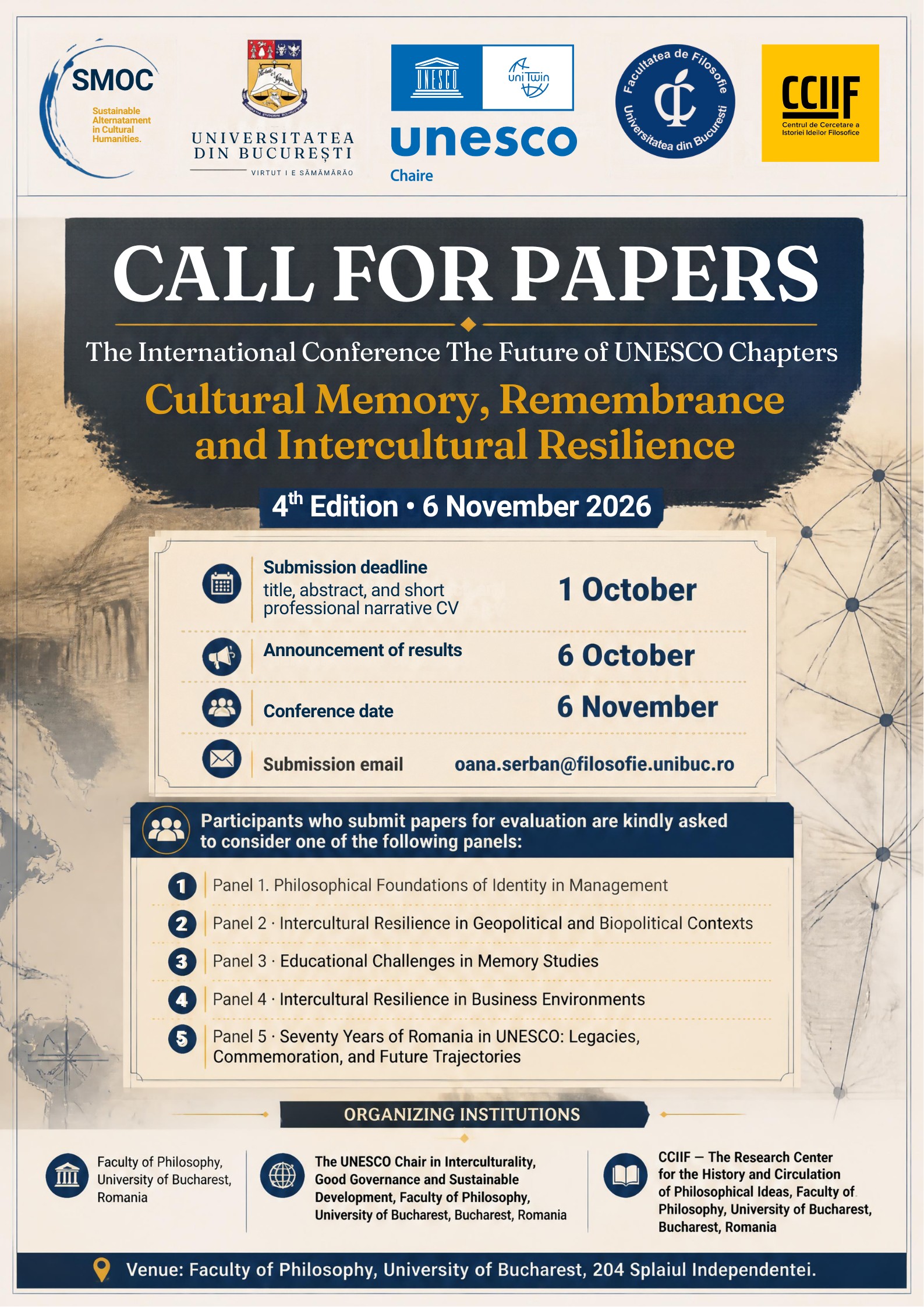
Organized under the aegis of the UNESCO Chair in Interculturality, Good Governance and Sustainable Development, at the Faculty of Philosophy, University of Bucharest, the annual international conference The Future of UNESCO Chapters: Cultural Memory, Remembrance and Intercultural Resilience engages multidisciplinary academic communities and practitioners to reflect on how philosophical insights inform and develop leadership, governance, and sustainable development in increasingly diverse organizational contexts.
The UNESCO Chair, active since 1999 and running internationally-oriented MA programmes in Intercultural Management, Communication and Business Administration, fosters a nexus between interculturality, philosophical grounding, and governance. Responding to UNESCO’s UNITWIN and SDG agendas, this event invites contributions that explore identity not merely as a personal or cultural signifier, but as a strategic and ethical dimension within leadership and organizational change.
This year’s edition is inspired by the broader context of the 70th anniversary of Romania’s accession to UNESCO (27 July 1956). Throughout 2026, the Romanian National Commission for UNESCO is running an extensive anniversary programme under the motto “Celebrating the Past, Building the Future Together.” It is our belief that this celebration must be embraced also by our UNESCO Chair, which has devoted the fourth edition of this annual conference to a special topic, Cultural Memory, Remembrance and Intercultural Resilience. The present conference joins this anniversary agenda, reflecting on how cultural memory, remembrance, and intercultural resilience connect seven decades of Romanian engagement with UNESCO to the collaborative governance of the future.
We welcome theoretical, empirical, and practice-based papers, including those offering rigorous philosophical analysis. Participants who submit papers for evaluation are kindly asked to consider one of the following panels:
Panel 1 · Artificial Intelligence and Virtual Cultural Memory: Challenges and Ethical Limits
- Digital reconstructions of cultural heritage and collective memory
- Virtual museums, digital archives, and “digital witnesses” of memory
- Algorithmic bias and distortions of AI-generated historical narratives
- Intellectual property, authenticity, and misinformation in digital representations of the past
- Ethical governance of emerging technologies in memory preservation
Panel 2 · Intercultural Resilience in Geopolitical and Biopolitical Contexts
- Migration, forced displacement, and the (re)construction of cultural identity
- Conflict, post-conflict settings, and memorial reconciliation
- Security, sovereignty, and the governance of cultural diversity
- Biopolitical narratives of resilience among transnational minorities
Panel 3 · Educational Challenges in Memory Studies
- Pedagogy of memory in academic intercultural environments
- Human rights education and the memory of collective trauma
- Training educators for diversity and interculturality
- Digitalization of memorial education and accessibility
- The role of universities and UNESCO Chairs in transmitting cultural memory
Panel 4 · Intercultural Resilience in Business Environments
- Intercultural leadership and the management of organizational diversity
- Resilience challenges within corporate governance frameworks
- Intercultural communication and negotiation in global business
- Corporate social responsibility and organizational memory
- Organizational resilience in the face of intercultural crises
Panel 5 · Seventy Years of Romania in UNESCO: Legacies, Commemoration, and Future Trajectories
- Romania’s accession to UNESCO and its evolving role within the organization
- Institutional memory: archives, commemorative practices, and the politics of anniversary-making
- UNESCO Chairs and national commissions as custodians and producers of cultural memory
- From commemoration to strategy: lessons from seven decades for future governance and intercultural cooperation
- Romanian contributions to UNESCO’s global agendas (heritage, education, sciences, culture) and their intercultural significance
Submission Guidelines
Interested participants are invited to submit, in a single document, the following:
- Paper title and full affiliation
- An abstract of the proposal
- A short professional narrative CV
Please indicate the panel for which you are submitting.
Submissions should be sent to: oana.serban@filosofie.unibuc.ro
Key Dates
|
Submission deadline |
1 October — title, abstract, and short professional narrative CV |
|
Announcement of results |
6 October |
|
Conference date |
6 November |
|
Submission email |
oana.serban@filosofie.unibuc.ro |
We look forward to your proposals and warmly invite you to contribute to this multidisciplinary reflection on cultural memory, remembrance, and intercultural resilience.
Organizing Institutions
Faculty of Philosophy, University of Bucharest, Romania
The UNESCO Chair in Interculturality, Good Governance and Sustainable Development, Faculty of Philosophy, University of Bucharest, Bucharest, Romania
CCIIF — The Research Center for the History and Circulation of Philosophical Ideas, Faculty of Philosophy, University of Bucharest, Bucharest, Romania
Organizing Committee
Prof. PhD. Viorel Vizureanu, Dean of the Faculty of Philosophy, University of Bucharest, Romania
PhD. Lecturer Oana Șerban, member YAE – Young Academy of Europe, Director of the Research Center for the History and Circulation of Philosophical Ideas, Faculty of Philosophy, University of Bucharest, Romania
PhD. Lilian Ciachir, Coordinator of the UNESCO Chair, Faculty of Philosophy, University of Bucharest, Romania
PhD. Candidate Victoria Tarnovschi, Faculty of Philosophy, University of Bucharest, Romania
Financial Information
Coffee breaks and lunch will be provided by the organizers. Participants are encouraged to apply to their institutions for mobility grants, including costs of accommodation. On request, we can provide a limited number of rooms at the Hotel Academica, the Guest House of the University of Bucharest, offered at a preferential fee for the participants of the conference.
__________________
This conference is an annual event organized under the framework of SMOC – Sustainable Management in Cultural Organizations (SMOC), Grant Agreement No. 10508/25.10.2024, funded through the Research and Development Project Fund “Grants for Enhancing Institutional Performance and Competences in Priority Areas” at the University of Bucharest, and is financed for Romanian participants exclusively by FSS GRANTS (University of Bucharest & Ministry of Education). Additionally, the two first panels are supported by the program BIOART – PN-IV-P2-2.1-TE-2023-0636, Biopolitical Art in the Post-Holocaust Age: Philosophical Perspectives on Aestheticized Testimonies, Politicized Aesthetics, and Bare Life, financed by UEFISCDI.